Saturday, January 2, 2016

Buenos Aires Tour and Uruguay

A view towards the Parliment bulding in main square with the Argentina flag flying above. 

Today we toured the city of Buenos Aires. Our tour guide Marcela took us through the city starting in the downtown area where we stayed last night. One interesting fact is that the North side of the city is Italian style and the South side is Spanish style. After that, we saw some of the major monuments throughout the city. 

One of the monuments we went to was the burial site for Eva Peron, the wife of one of the past presidents that was overthrown. Eva passed away when she was only 33, and her body was stolen. It was recovered and transferred to Europe where it stayed for several years. It is back in Argentina now.


We also visited the Basilica in Buenos Aires. It was where the current Pope Francis conducted mass before he was named Pope. There is a Jesus statue in the Basilica that was donated by one of the soccer teams who had bought it for good luck when they were winning many of their games.


Towards the end of the tour, we visited one of the major soccer (futbol) stadiums. There are 20 different minor league soccer teams throughout the city. One of the main teams wears red and white colors which respresents the upper class and the other main team is blue and yellow (boca) which represents the middle/poor class. It was a pretty neat experience. We toured the Boca team stadium. It holds 50,000 people.


After lunch by the river, we boarded the ferry headed to Uruguay. We arrived safely to a beautiful hotel in La Colonia.


Submitted by Lexi Jennings and Chelsea Jennings 

View of the skyline of the newest part of Buenos Aires that has only been developed since 1998  where many of the  factories along the river were restored and converted to high-end condos, restaurants and the theatres 

Students at the Boca Futbol (Soccer Stadium)

In the Government area called Main Square this was the early Spanish Goverment house that is now a museum. 

The group standing in front of the Parliment House which is now home of the new Goverment which took office on November 22nd ander President Macri and has the agricultural community excited about the future of Ag policy and the reduction of taxes. 

Students Austin, Jacob, Derek and Lexi preparing for their first Ferry ride. The  Ferry travels across the river between Argentina Dan Uruguay on a regular basis and makes easy access between the two countries. 

Touring the big city

Today we will be touring the historical and cultural sites of Buenos Aires before we take a Ferry ride across the 35 mile river to Uruguay to start our tours there. Check in later for updates from our tour. 


Hampshire down

Today we visited La Constancia, a farm about 4 hours away from Buenos Aires. Roberto, the owner and operator gave us a nice tour of his small farm which mostly produces registered Hampshire sheep for shows and breeding stock. He is the third generation operating this farm; which was established by his great grand-father an Italian descendant in 1911. A few years later, in 1919 they built the clay house they still live in today.

After a short introduction to the farm, we were seated for a typical Argentinian meal of bread, salamis and cheese, salad, pork cooked on asado (what we were refer to BBQ but the taste of the wood used really comes through), and then dessert. The food and hospitality here in Argentina is incredible!

An example of the meats and cheese appetizer plate we were served 

Roberto has about 60 hectares of land which adds up to about 150 acres. On this limited land, about 15 hectares are devoted to pasture for the sheep and the rest is cropland. He mostly raises corn to feed his flock but he also raises some soybeans to keep a rotation. The pasture consists of alfalfa as well as some volunteer brome and other grasses. This is able to feed about 30 sheep per hectare of pastured land.


Some of the yearling hampshire rams grazing the alfalfa. 

Roberto´s sheep do very well in the 15 shows he attends throughout Argentina and he tries to send his best animals to the Paleramo Show, because that is the most prestigious show in the region. Roberto sells about 80% of his sheep privately right on his farm but he also sells some at shows, as they can bring a lot more money there. 

Submitted by Paul Sitter.

Friday, January 1, 2016

Ringing in New Year in Argentina

Happy New Year from the students. We had a good time ringing in the Argentine New Year and will post a photo later today. We are headed to a farm visit and then back to Buenos Aires today. 

Happy New Year to all our family and friends back home. 

The group on New Year´s Eve before we had a three course meal in which the restaurant provide us a menu in English just for us as well as English speaking waitress. Later the students got to join other residents from the area to dance the night away. 


Thursday, December 31, 2015

Angus Cattle, Angus Asado

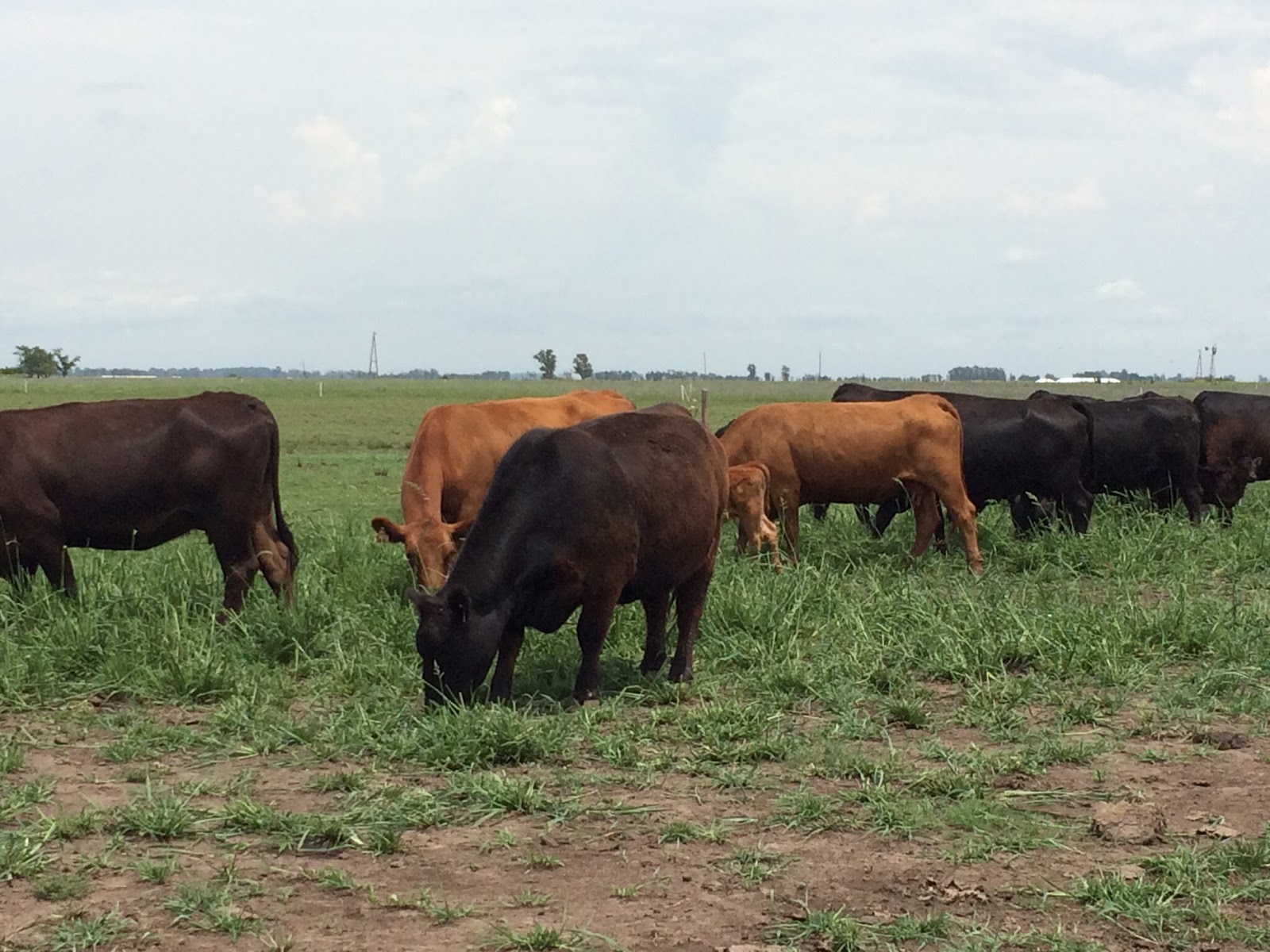
Some of the registered Black and Red Angus herd. Genetics seen here also consist of bloodlines from American  Angus herds. 


Alejendro had a top quality herd of Angus Cattle and even did embryo transfer 

Students viewing the cattle handling facilities made of all wood that had an extensive catwalk system. 
Discussing the cattle portion of Calderon  family farm I will focus on their Angus operation. Alejandro is the name of the owner of the operation. He has a herd of 350 black and red Angus cattle. In Argentina, black and red Angus are considered one breed, as compared to the U.S. where they are two seperate entities. His herd of 350 consists of 120 registered cattle and the remaining 230 are commercial cattle. With the 120 registered cattle, he raises seedstock bulls and heifers. Hosting his own bull sale each year. He sells the bulls as two-year olds and the heifers as yearlings. On average he sells 75 to 90 bulls, ranging in price from $2,000 to $4,000. The remaining calves he backgrounds, and then sells at the local market. 

Talking with Alejandro about his cow herd I also learned about some of his herdsman techniques. He artificially inseminates his whole cow herd in a 60 day period and then puts cleanup bulls out with the herd for 25 more days. Talking about how he feeds his cattle, I discovered that his herd of cows graze year round. They are not fed at all. But his bulls and background calves are fed different rations of hay, silage, and corn. Today, we viewed some of his yearling and two-year old bulls, along with some of his registered cow herd. 

An aspect of his operation that I greatly enjoyed, was the fact that he implements rotational grazing. He uses a grazing system that is similiar to the mob grazing system that some ranchers use in the U.S. With this system the cattle are moved to a different portion of the pasture everyday to graze new grass. This stimulates better quality and quantity of grass growth. It was a learing experience for me because we implement similiar grazing techniques on our own operation.

Overall, the visit to today's farm was very educational and very fun. I learned many different techniques and compared a lot of them to our own in the U.S. I am definitely looking forward to our next farm visit.

Submitted by Austin Effling, the portion of the cropping information from this farm was reported by classmate Derek Van Heek 

Studying Year Round Farming

It was a beautiful morning in Melincue, Argentina with a temperature of 26 °C (78.8°F). We started our day out with a typical Argentinian breakfast consisting of pasteries, fresh fruit, and coffee. Then we traveled 60 miles to visit and study at an Argentinian farm owned, and managed by Alejandro Calderon. Alejandro was an agronomist and very sharp with the details involved in his large farming operation.

Alejandro owns 282 hectares which is 696.8 acres. He also rents and manages 800 hectares (1,976 acres) from other land owners. It is very common for land owners to hire a third party, or an outside producer, to help manage farm ground in Argentina since input costs, like machinery are too high priced  for smaller operators to afford. Alejandro owns all the machinery necessary to do planting, spraying, harvesting, and transporting. He practices mainly no till on his ground and said he does not apply any more chemical than he has to, due to weeds becoming resistant to certain herbicides like Roundup. Some of his farming practices are similar to those in the US, but overall, producers in Argentina have a much more conservative approach.

For being a rather large operation, they used older machinery than what is generaly used on convential farming operations in North America. The farm ground we studied today was very fertile, the soil was comparable to the soil in Illinois. The land here is very flat and generally recieves 40-44 inches of rain a year. This makes drainage a problem for the farmers. Alejandro mentioned they were late getting crops planted this spring due to excessive rains. I asked him if drainage tile was commonly used to fix this problem. He said it was too costly and he would have to go very far with the water to get rid of it. He used his farm ground mainly to produce wheat and green pea´s in the winter months and corn and soybeans in the summer. 

We ended the tour of his farming operation with a traditional asado meal prepared by Alejandros wife, Maria and hired man, Hector. By the end of the day it was over 100°F so the cold beverages and well prepared meal was greatly appreciated! 

Submitted by Derek Van Heek. I discussed the crops at this operation and my fellow student Austin Effling with next discuss the livestock portion of our visit. 
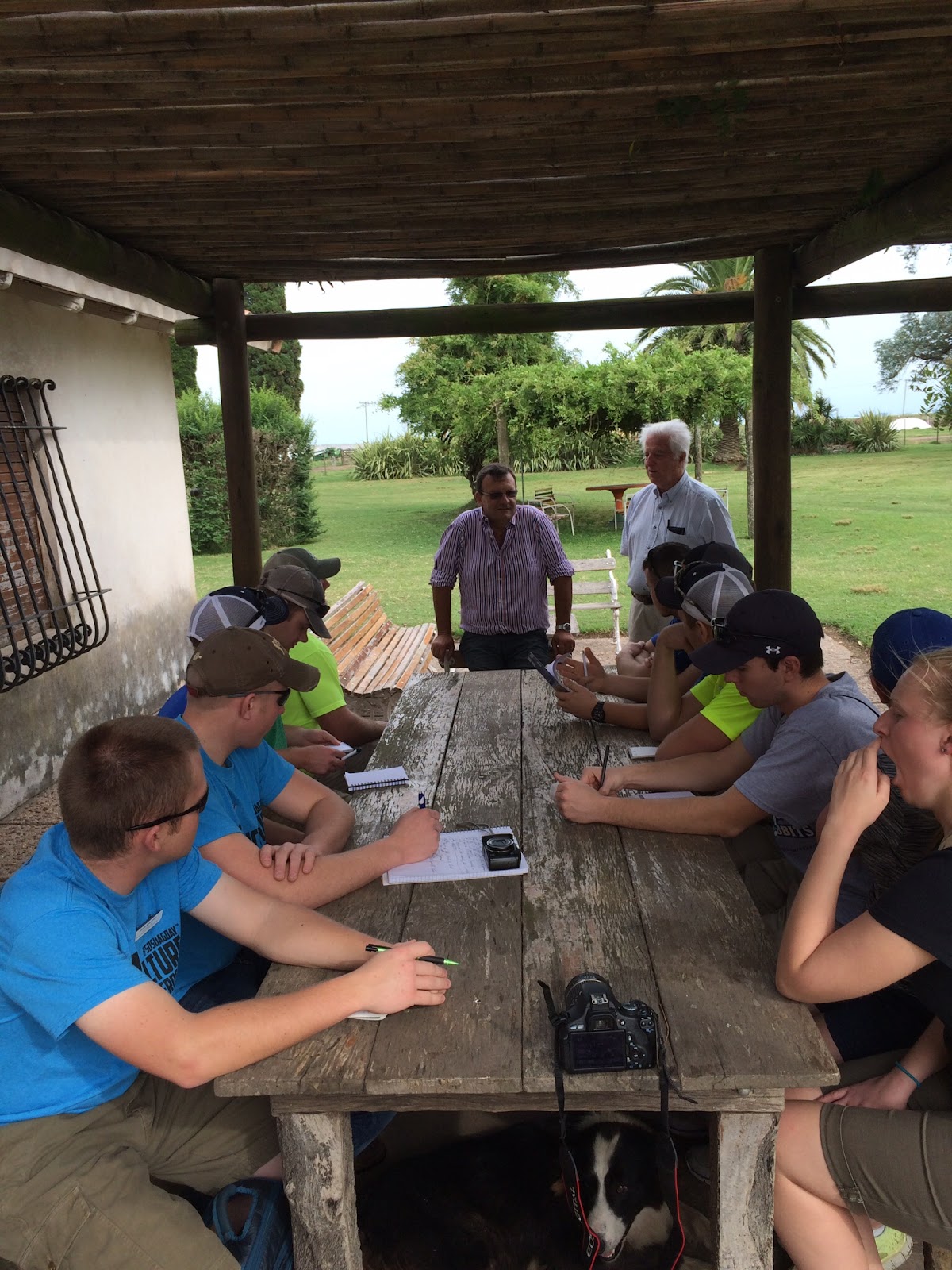
Alejandro discussing his farming and cattle operation with the students and interpreted by Jorge to the students. 
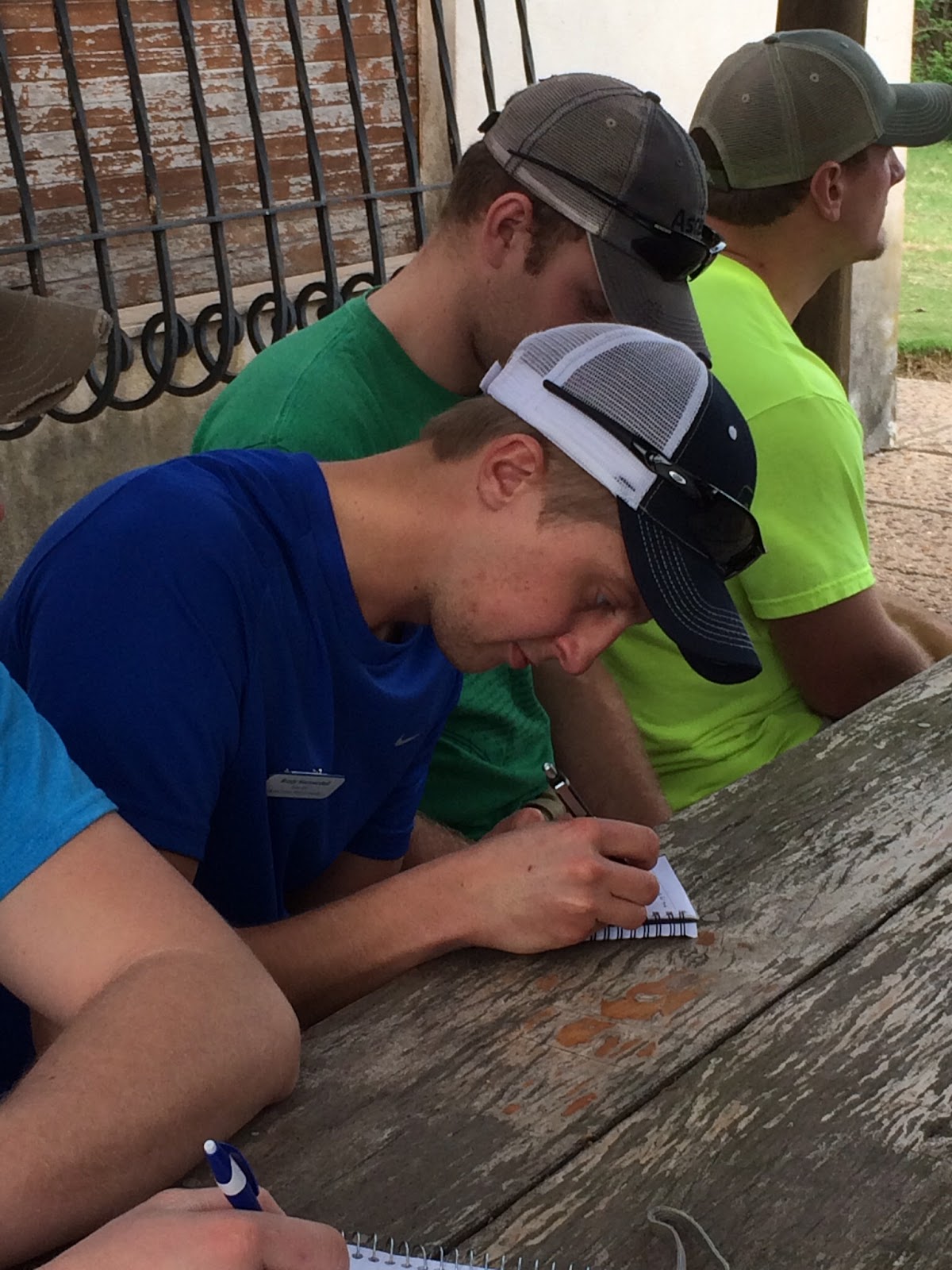
Brady H takingdetailed notes during Alejandro's discussions about crop operations in Argentina. 

Lexi Jennings studying the handout presented by Alejandro about his farming operation including detailed maps about  crop rotation history for past 15 years. 

Equipment owned by the farm. 

Students viewing corn planted 25 days ago into a field which previously was pastureland but tilled up for crop. Corn was late in planting due to recent excessive rainfall.

Ten year old New Holland combine that is worth more in dollar value now than when purchased due to demand for equipment for cropping in Argentina. 

Wednesday, December 30, 2015

All aboard

The second day of our adventure started with a typical Argentine breakfast consisting of with pasteries and juice. We left the hotel and headed to the marina where the Miss Litoral Argentino awaited our arrival to start our voyage. We started up the 3rd largest river in South America, the Parana River, just outside of Rosario which carries five times the amount of water that the Mississippi River. The Parana River moves large quantities of silt downstream and the locals like to say, "Brazil is melting and we are gaining their ground." Due to high rainfall, the Parana has been experiencing flooding in the recent weeks. There has been recently an estimated loss of one million cattle due to the high water rising above the island banks. The flood was especially apparent as large clumps of aquatic vegetation were floating with the current. We were told these grass clumps often carry large snakes and alligators down stream.

As we headed upstream toward the grain terminals, our tour guide, Jorge, explained that the river must be 32-35 feet deep for the Paramax to travel the river. The Paramax is a term for ships that are eligible to use the Panama Canal. These ships can be loaded with 60,000 tons of grain in 1 1/2 days.  We saw numerous ships being loaded with grain to be shipped all over the world. There were some from Greece, Panama, and Hong Kong to name a few.

We learned that much of the grain that is produced around Rosario and Buenos Aires is sold by the farmer directly to the terminals. Many barges bring the grain down the length of the river from inland to load the Paramax and some also go out to the ocean. From the terminals, the large Paramax ships travel 500 kilometers to the Atlantic to start their haul. After 40 kilometers of our own haul, we finished the day with a lunch of fish and ice cream while enjoying the view of the Parana River.

Submited by Jalen Baldwin 
As we were riding in our boat down the river along came a large Paramax Vessel, it was huge and very neat to be going right beside it. It passed us in no time as we determined it was from Greece and was empty on its way here to pick up more grain. 
Dust showing the loading of the Paramax vessell and how close we really got to it. this was at the Cargill Terminal 
Some of the cement storage bins at the terminals along the river

Another view as we approach a vessell along its terminal loading system 

This was a very of a Paramax vessell at the Cargill Terminal on the River 
It has been hot here....our bus showed 38 degrees celcius today...over 100 F and it has been tht since we have arrived.