Monday, January 4, 2016

First Hand Look at Uruguay Crops

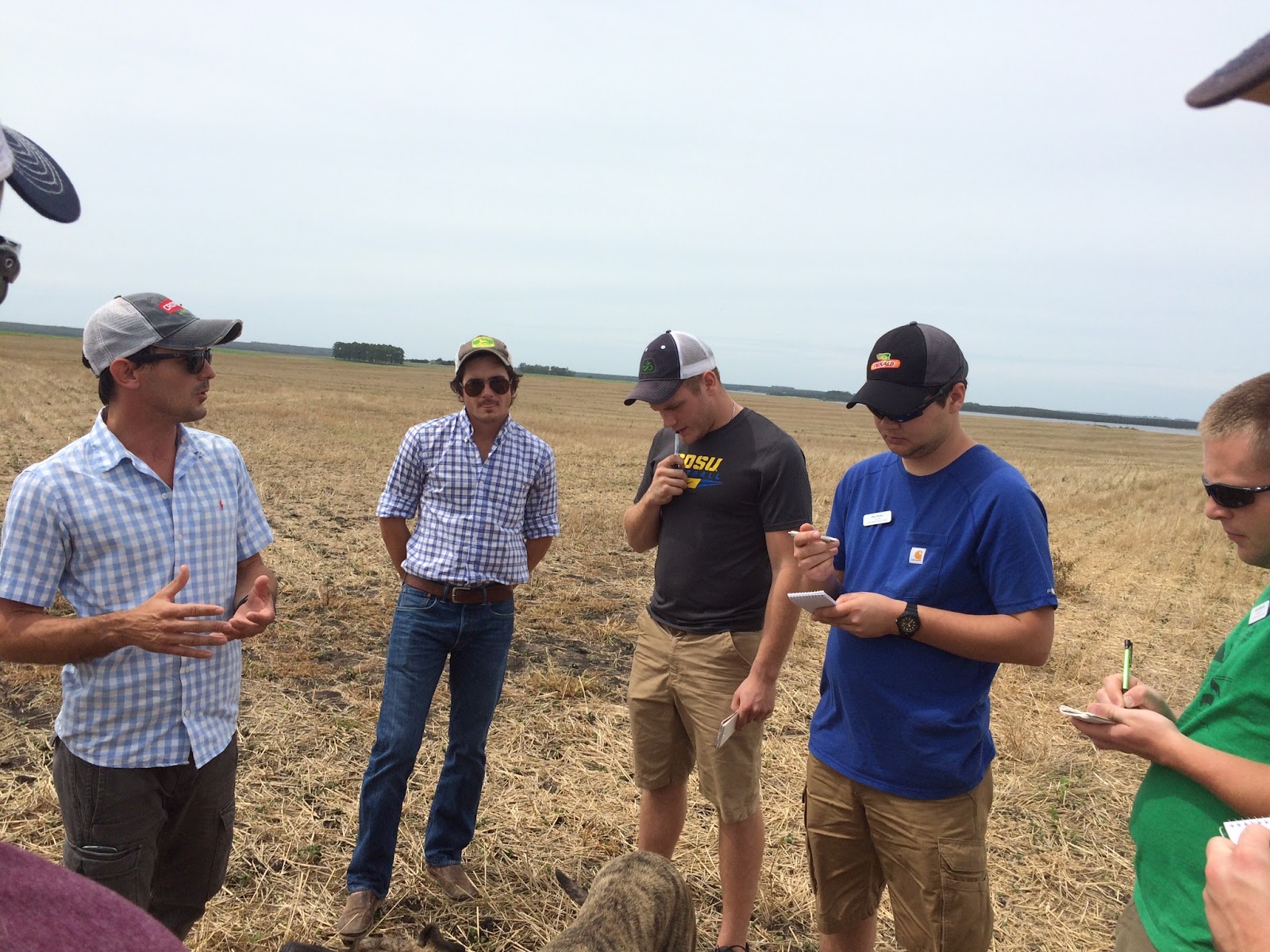
Today we went and looked at a farm that was managed by Santiago Narbaiz, his brother Jouquin, and another team member Juan. Santiago and Jouqin own their own crop consulting and farm management company called Servi Charca or Field Service. Their main focus is consulting and managing land for foreign investors from the United States and the United Kingdom. Santiago also spent a year in North Dakota working on a crop and cattle farm.


The team from Servi Charca explaining to the students about agronomy in Uruguay, Juan, Jouquin and Santiago. 


The main crops that are grown by Santiago and Jouqin are soybeans, wheat, and corn. They also have some barley and canola within some rotations. A typical crop rotation in Uruguay for double crop  consists of soybeans followed by either wheat, barley, or canola. For a single crop it consists of a cover crop of oats followed by a full season soybean or corn. Typical maturity groups for Uruguay soybeans in this area are group 5 to 6, compared to group 2 in the northern Midwest. Corn maturity is 190 to 210 for a single crop, and 180 for a double crop compared to the upper Midwest were we plant 93-105 day corn.

No cold winters in Uruguay and direct/no-till planting result in a higher pest pressure than found in the upper Midwest. Even though Uruguay is located in the Southern Hemisphere, they deal with many of the same pests we do in our backyard. Some of the main insects include grasshoppers, stink bugs, caterpillars, thrips, and spider mites. They recently sprayed an insecticide that will give them 20 days of protection against insects. They also deal with similar fungal and bacterial diseases that we do in the U.S. As in the U.S. they are also dealing with Roundup resistant weeds, which include marestail and ryegrass. To combat herbicide resistance they are beginning to use many different herbicides similar to those in the U.S.

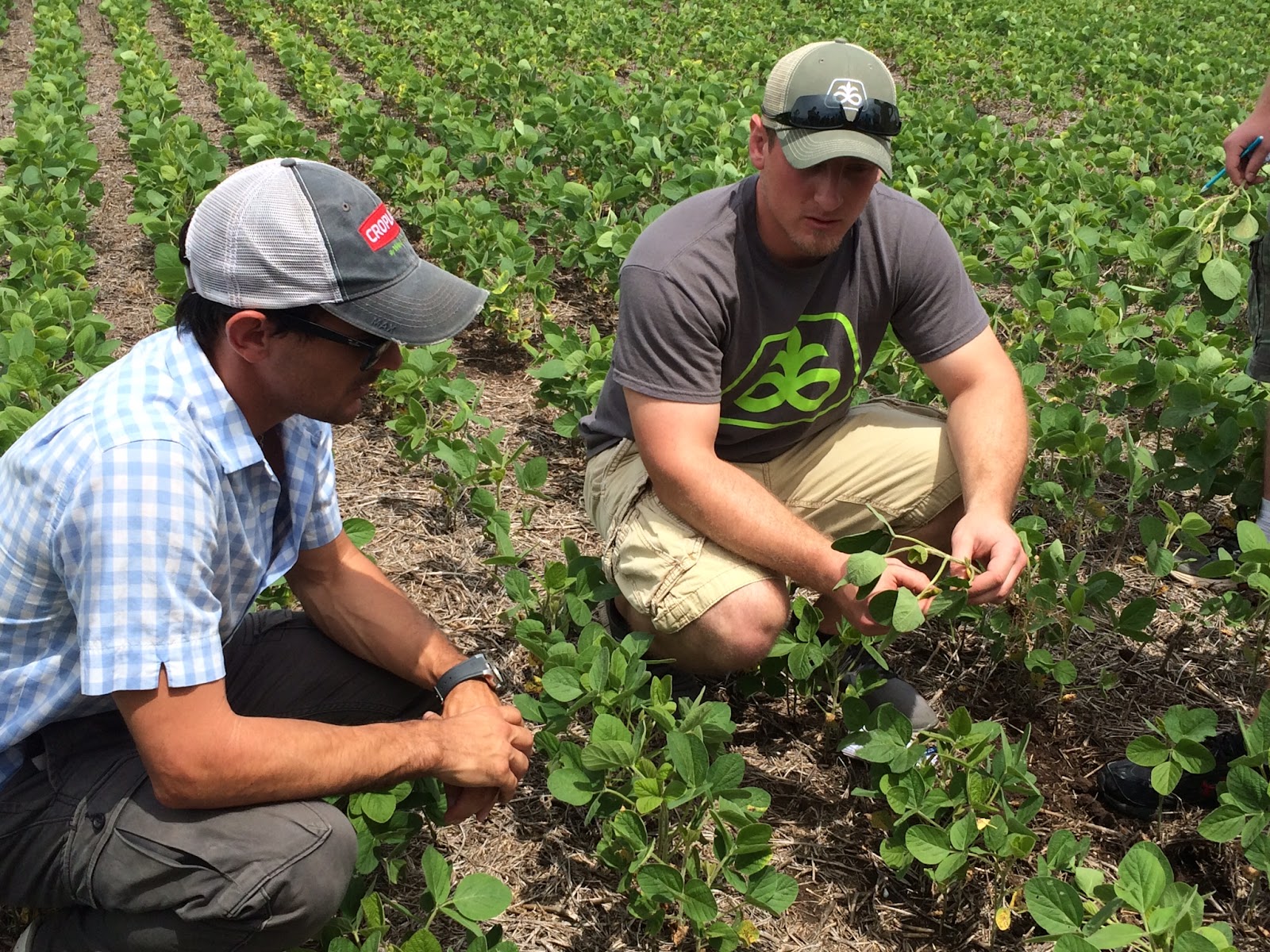
Students Jalen Baldwin and Dan Hansen taking a close look at Soybeans that were planted around Nov 20th. 


Soil type and topography influence crop management practices. Most crops here are no-tilled/ direct planted into the prior crops stubble. This helps to reduce soil erosion from high rainfalls and rolling land. No-till leads to problems nutrient availability in their soil, because there is no mixing of soil most nutrients are in the top few inches. Compaction is also a problem that arises from no-till farming in Uruguay. Santiago is planning on adding tillage into his cropping rotation to help minimize this problem.


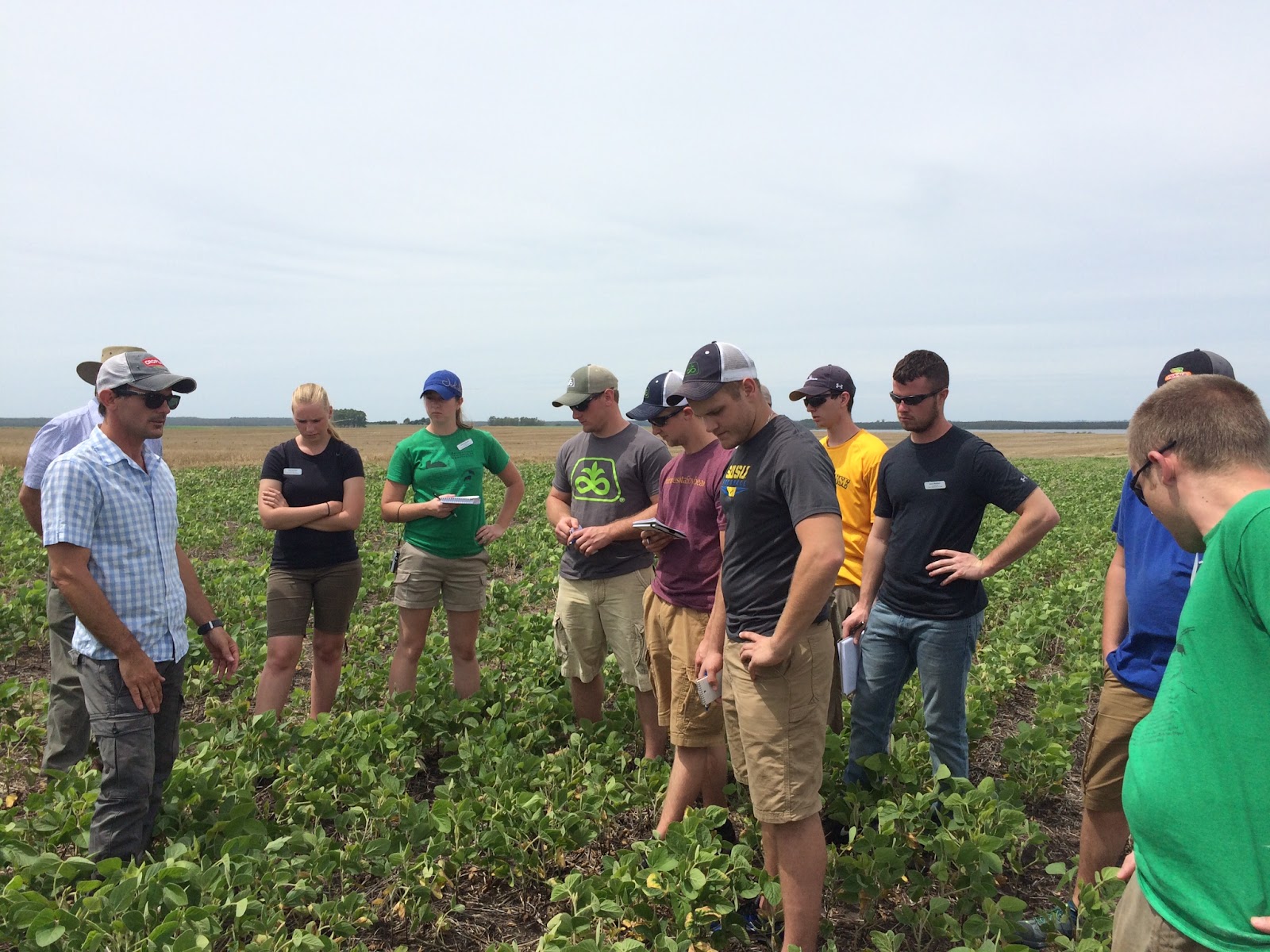
Santiago provided a lot of data for the students on common yields, seeding rates, rotations etc., and the students were filling there notebooks fast taking it all in. 


A full morning was spent looking at soybeans in various stages from a week planted to almost 2 months, and students had many questions about how the rotations of year round cropping worked. 

Since the farms Santiago manages are so far away from each other he has to hire customer planting and harvesting at some farms. Santiago does own his own equipment but can't move them from farm to farm due to the long distance. Most of his equipment is bought in the U.S. and shipped to Uruguay because the prices are higher here. Many farmers here use the same equipment as we do equipped with similar GPS and yield monitoring systems. 

Santiago and Dale McMullen discussed in depth some options to deal with certain issues on this particular crop and what protocols would be used in the U.S. 

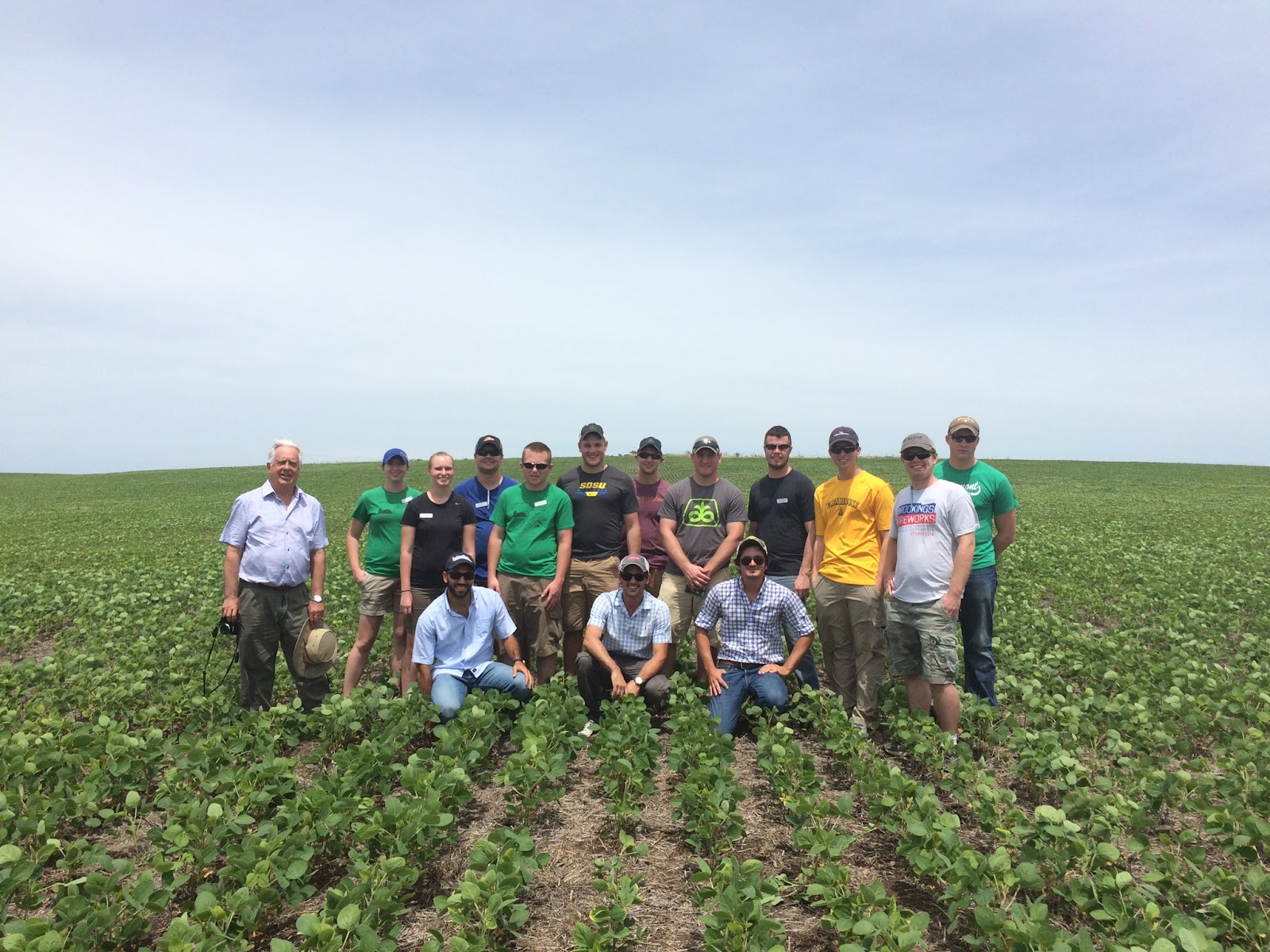
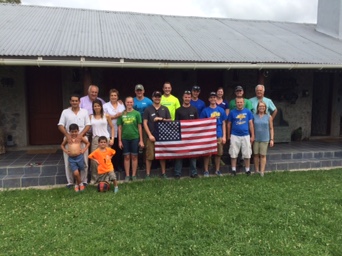
The Servi Charca team challenged the SDSU students to study this field and offer suggestions for the next step of weed or herbicide control, afterwards the group gathered for a photo. 

The tour today showed us how crop production is similar and different from our home areas.. Many of the same crop management techniques are used in Uruguay as in the U.S., even though the growing season here is different. We would like to thank Santiago, Jouquin, and Juan for inviting us on a tour of their farm. 


For one day Uruguay and the U.S. Joined forces to discuss common agriculture issues especially those focused around agronomy. 


Submitted By Jason Madison & Dale McMullen

Uruguay Crops

Yesterday we were lucky and had cloud cover but today it looks like on our crop walk tour today the heat and humidity is back. We will be spending the day seeing intensively the agronomic side of the agricultural industry in Uruguay and look forward to reporting back later today. 

Thanks for your patience as we post articles and photos, sometimes wi-if access is good other times slower than we are used to. 

Have a great day. 


Sunday, January 3, 2016

The Breed of Uruguay Visit

Today on our adventure in Uruguay we visited a one of the country's top Polled Hereford  seedstock producers. The majority of cattle in Uruguay are of the Hereford breed.  This is a family run farm that specializes in Polled Hereford cattle but do also have another herd of cattle based on Angus genetics which was started by their great grandfather. The farm name was Sociedad Ganadera San Salvador. They have 150 head of registered Polled Hereford cattle which they focus on raising bulls and breeding emails. Every October they conduct a bull sale where they sell 80 bulls and 20 heifers. They sell their bulls as two-year olds, and the heifers as open yearlings. Their genetics are extensively base on U.S. Seedstock genetics they select from trips to the U.S., and following the U.S., Hereford and Angus bloodlines.

One of the Fernandez Family's Polled Hereford Herd Bull's we viewed. 

In discussing their cow herd I learned they do not breed their first calf heifers until they are two-year-olds. They do this to make sure the heifers are mature before they are bred and calve. Their cow herd is never fed, similar to the Angus farm we visited a few days ago. The cow herd grazes year round. The bulls graze up until the sale, but about five months prior to the sale they are fed a supplemental grain ration of corn and oats while still on grass. We got to see all their bulls, including their herd bulls and the bulls they collect semen from. 

Another Polled Hereford bull that is the product of  the genetics as Sociedad Ganadera San Salvador . 


After viewing their cattle we spent the majority of the afternoon eating Asado (BBQ beef in South America) and enjoying everyone's company as we continued to discuss beef cattle. This farm visit was an exceptional stop and very knowledgeable for everyone. I hope in the future we can continue to have as quality visits as this one.


Master chef Luis Fernandez, owner of San Salvador with his family cooked up an awesome beef Asado. He cooked 22 lbs of beef and our students ate it all!!


Student Jason Madison presenting some thank you gifts to the family. 


The SDSU Students saying with the Fernandez family after a wonderful visit learning about the cattle industry in central Uruguay. 


Submitted by Austin Effling

Saturday, January 2, 2016

Buenos Aires Tour and Uruguay

A view towards the Parliment bulding in main square with the Argentina flag flying above. 

Today we toured the city of Buenos Aires. Our tour guide Marcela took us through the city starting in the downtown area where we stayed last night. One interesting fact is that the North side of the city is Italian style and the South side is Spanish style. After that, we saw some of the major monuments throughout the city. 

One of the monuments we went to was the burial site for Eva Peron, the wife of one of the past presidents that was overthrown. Eva passed away when she was only 33, and her body was stolen. It was recovered and transferred to Europe where it stayed for several years. It is back in Argentina now.


We also visited the Basilica in Buenos Aires. It was where the current Pope Francis conducted mass before he was named Pope. There is a Jesus statue in the Basilica that was donated by one of the soccer teams who had bought it for good luck when they were winning many of their games.


Towards the end of the tour, we visited one of the major soccer (futbol) stadiums. There are 20 different minor league soccer teams throughout the city. One of the main teams wears red and white colors which respresents the upper class and the other main team is blue and yellow (boca) which represents the middle/poor class. It was a pretty neat experience. We toured the Boca team stadium. It holds 50,000 people.


After lunch by the river, we boarded the ferry headed to Uruguay. We arrived safely to a beautiful hotel in La Colonia.


Submitted by Lexi Jennings and Chelsea Jennings 

View of the skyline of the newest part of Buenos Aires that has only been developed since 1998  where many of the  factories along the river were restored and converted to high-end condos, restaurants and the theatres 

Students at the Boca Futbol (Soccer Stadium)

In the Government area called Main Square this was the early Spanish Goverment house that is now a museum. 

The group standing in front of the Parliment House which is now home of the new Goverment which took office on November 22nd ander President Macri and has the agricultural community excited about the future of Ag policy and the reduction of taxes. 

Students Austin, Jacob, Derek and Lexi preparing for their first Ferry ride. The  Ferry travels across the river between Argentina Dan Uruguay on a regular basis and makes easy access between the two countries. 

Touring the big city

Today we will be touring the historical and cultural sites of Buenos Aires before we take a Ferry ride across the 35 mile river to Uruguay to start our tours there. Check in later for updates from our tour. 


Hampshire down

Today we visited La Constancia, a farm about 4 hours away from Buenos Aires. Roberto, the owner and operator gave us a nice tour of his small farm which mostly produces registered Hampshire sheep for shows and breeding stock. He is the third generation operating this farm; which was established by his great grand-father an Italian descendant in 1911. A few years later, in 1919 they built the clay house they still live in today.

After a short introduction to the farm, we were seated for a typical Argentinian meal of bread, salamis and cheese, salad, pork cooked on asado (what we were refer to BBQ but the taste of the wood used really comes through), and then dessert. The food and hospitality here in Argentina is incredible!

An example of the meats and cheese appetizer plate we were served 

Roberto has about 60 hectares of land which adds up to about 150 acres. On this limited land, about 15 hectares are devoted to pasture for the sheep and the rest is cropland. He mostly raises corn to feed his flock but he also raises some soybeans to keep a rotation. The pasture consists of alfalfa as well as some volunteer brome and other grasses. This is able to feed about 30 sheep per hectare of pastured land.


Some of the yearling hampshire rams grazing the alfalfa. 

Roberto´s sheep do very well in the 15 shows he attends throughout Argentina and he tries to send his best animals to the Paleramo Show, because that is the most prestigious show in the region. Roberto sells about 80% of his sheep privately right on his farm but he also sells some at shows, as they can bring a lot more money there. 

Submitted by Paul Sitter.

Friday, January 1, 2016

Ringing in New Year in Argentina

Happy New Year from the students. We had a good time ringing in the Argentine New Year and will post a photo later today. We are headed to a farm visit and then back to Buenos Aires today. 

Happy New Year to all our family and friends back home. 

The group on New Year´s Eve before we had a three course meal in which the restaurant provide us a menu in English just for us as well as English speaking waitress. Later the students got to join other residents from the area to dance the night away.